Service Flow Model (TFM)
PA_VT_0026 · N4
How do the service's components interact in the flow through information that is received and passed on?
One Service Flow Model, two perspectives
The Service Flow Model shows how the parts of a service interact through what they receive and deliver. The AS-IS perspective uses artefacts, I42, to describe the concrete inputs and results handled. The TO-BE perspective uses information objects, I31, to describe the information needed and passed on without tying the solution to a particular artefact. AS-IS and TO-BE identify the perspective of these examples, not a general restriction on when either object type may be used.
The examples show inputs and outputs, not a complete flow. Artefacts can be tangible things other than documents. The perspectives do not imply automatic reclassification from I42 to I31.
Read the method: from concrete artefacts to traceable information
AS-IS: concrete realization
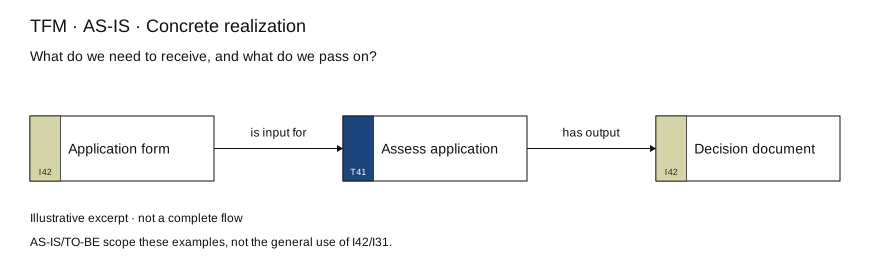
Application form (I42) is input for Assess application (T41). Assess application has output Decision document (I42).
TO-BE: information needs
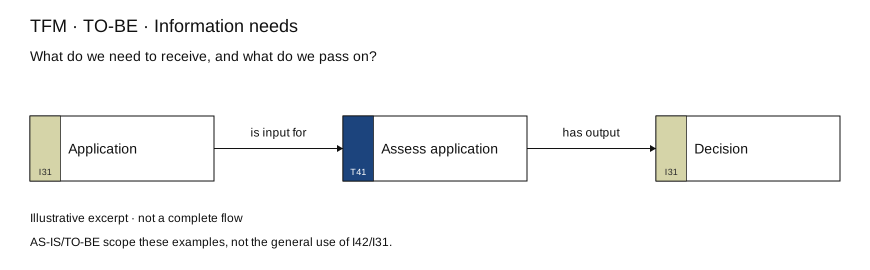
Application (I31) is input for Assess application (T41). Assess application has output Decision (I31).
Full reference: objects, relationships and definitions (HTML) · Same reference as JSON