
N3 · Allocation
Information Allocation Description (InfoOB)
A visual description of a selected information object and a selection of its relationships with its surroundings, scoped by a business question.
Purpose
Explain the context of the selected object through focused examples, rather than showing every possible relationship at once.
How to use the view
Place one focus object at the centre. Select only the surrounding objects and direct relationships that answer the question. Preserve relationship direction and meaning. Use the established notation and typography.
Choose the question you want to answer
The examples show focused selections. Each image is a schematic example, not the complete view type metamodel.
What do we need information about?
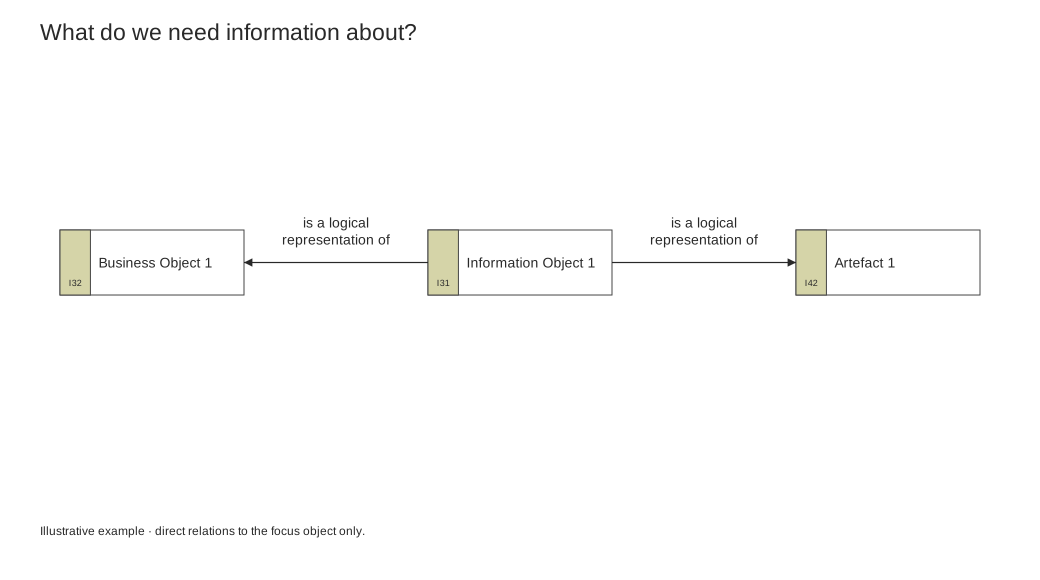
Read the example and its relationships → · Open larger image
Where is the information needed, and where does it come from?
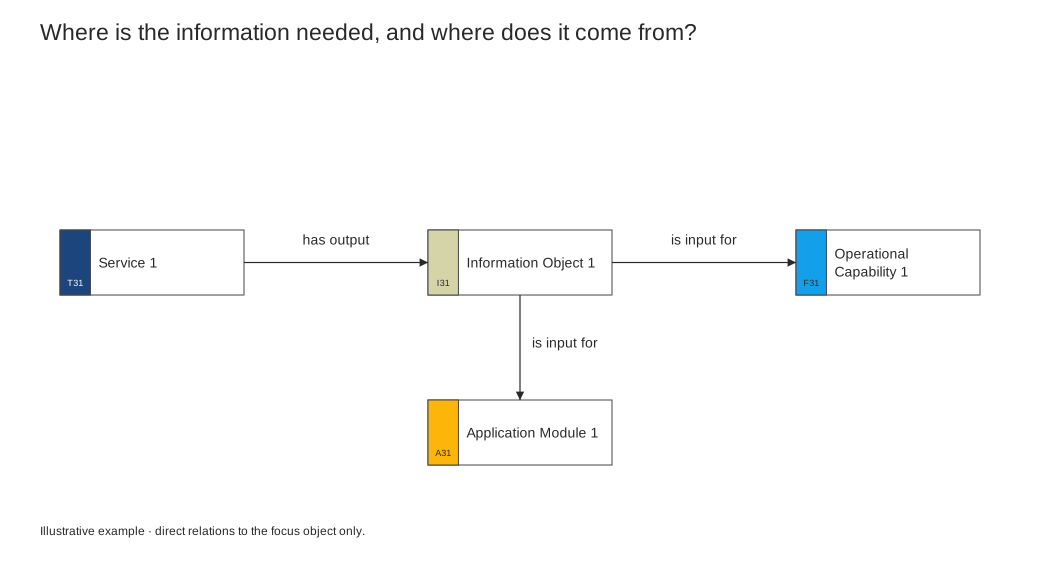
Read the example and its relationships → · Open larger image
How is the information realized in our systems, and what requirements must we consider?
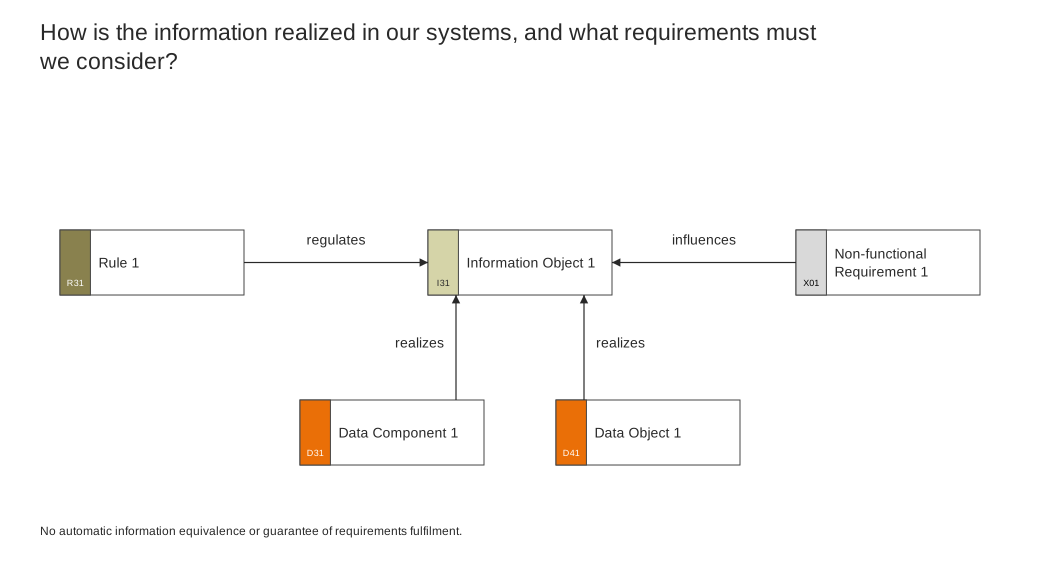
Read the example and its relationships → · Open larger image
Object types and relationships included in the view
PA_VT_0068
- IM31 — Capability
A substantial deliverable designed for release at intervals of two to three months.
- IM21 — Epic
A very substantial deliverable that brings about a major change affecting several value streams.
- O32 — Business Role
Assigned responsibility at the organizational level for performing a particular task.
- O42 — Organizational Role
Assigned responsibility at the team level for performing a particular task.
- IM32 — Release
A work package representing the set of work activities needed to produce a substantial deliverable within a specified time and resource frame.
- FD33 — Material
Tangible physical matter or physical elements.
- I42 — Artefact
A real, tangible thing that is significant and has substantial value.
- X01 — Non-functional Requirement
A statement of a desired quality attribute of a solution.
- I32 — Business Object
A representation of a real-world thing that is significant to the business.
- A32 — Application Interface
An access point through which an application service is made available to a user or another application module.
- I41 — Entity Group
A grouping of information entities intended to achieve efficient information provision and high information quality.
- A31 — Application Module
An independent logical part of a larger application that has been given a specific purpose.
- A21 — Application
IT support that users commonly refer to when describing the systems they work with.
- D41 — Data Object
A logical grouping of data that represents a view of an information object.
- D31 — Data Component
A coherent collection of data that is part of an application.
- I51 — Information Entity
An encapsulation of information representing a uniquely identifiable body of information.
- I31 — Information Object
A representation of information about a real-world thing.
- I22 — Information Flow — Approved, implementation pending
A grouping of information that together forms a flow.
- I21 — Information Group
A grouping of information objects or entity groups intended to provide an overview and structure.
- T41 — Service Component
A subset of the business logic realized so that a service can be delivered.
- T31 — Service
Something a business offers to meet a recipient's need, with a clear boundary and conditions for its use.
- F51 — Detailed Functional Capability
A logical grouping of functional requirements that defines the ability to perform a task.
- F41 — Functional Capability
The ability to perform a task.
- F32 — Business Function
A grouping of logically related tasks required to produce an outcome.
- F31 — Operational Capability
A holistic description of the business's ability to produce services and products efficiently.
- F21 — Business Capability
A holistic description of the business's ability to produce services and products in accordance with its vision and goals.
- R31 — Rule
Specifies the absolute norms that govern our conduct in a given situation.
- O41 — Organizational Team
A group of people who together possess the skills needed to create value in the business, also called a team.
- O31 — Organizational Unit
A specialized functional division within an organization, also called a department.
- Application has output Information Object · PA_RL_0022
- Application Interface has output Information Object · PA_RL_0067
- Application Module has output Information Object · PA_RL_0080
- Data Component realizes Information Object · PA_RL_0210
- Data Object realizes Information Object · PA_RL_0217
- Detailed Functional Capability has output Information Object · PA_RL_0236
- Entity Group is part of Information Object · PA_RL_0255
- Functional Capability has output Information Object · PA_RL_0323
- Non-functional Requirement influences Information Object · PA_RL_0356
- Information Entity is part of Information Object · PA_RL_0388
- Information Object is input for Business Function · PA_RL_0393
- Information Object is logical representation of Business Object · PA_RL_0394
- Information Object supports Operational Capability · PA_RL_0395
- Information Object is input for Application Module · PA_RL_0396
- Information Object generalizes Information Object · PA_RL_0397
- Information Object is input for Business Capability · PA_RL_0398
- Information Object is part of Information Group · PA_RL_0399
- Information Object is input for Service · PA_RL_0400
- Information Object is input for Service Component · PA_RL_0401
- Information Object is logical representation of Artefact · PA_RL_0403
- Information Object is input for Functional Capability · PA_RL_0404
- Information Object is input for Detailed Functional Capability · PA_RL_0405
- Information Object is input for Application Interface · PA_RL_0406
- Information Object is input for Business Role · PA_RL_0409
- Information Object is input for Operational Capability · PA_RL_0410
- Information Object is input for Application · PA_RL_0411
- Information Object is part of Epic · PA_RL_0412
- Information Object directs Capability · PA_RL_0413
- Information Object is part of Information Flow · PA_RL_0414
- Information Object is input for Organizational Role · PA_RL_0415
- Information Object is input for Organizational Team · PA_RL_0416
- Operational Capability has output Information Object · PA_RL_0555
- Rule regulates Information Object · PA_RL_0684
- Release changes Information Object · PA_RL_0802
- Service has output Information Object · PA_RL_0851
- Service Component has output Information Object · PA_RL_0863
- Business Capability has output Information Object · PA_RL_0889
- Business Function has output Information Object · PA_RL_0893
- · PA_RL_1065
- · PA_RL_1069
- Organizational Team has output Information Object · PA_RL_1230
- Organizational Unit has output Information Object · PA_RL_1234
- Information Object is input for Organizational Unit · PA_RL_1235