
N3 · Allocation
Application Allocation Description (AOB)
A visual description of a selected application module and a selection of its relationships with its surroundings, scoped by a business question.
Purpose
Explain the context of the selected object through focused examples, rather than showing every possible relationship at once.
How to use the view
Place one focus object at the centre. Select only the surrounding objects and direct relationships that answer the question. Preserve relationship direction and meaning. Use the established notation and typography.
Choose the question you want to answer
The examples show focused selections. Each image is a schematic example, not the complete view type metamodel.
How does the system support our work?
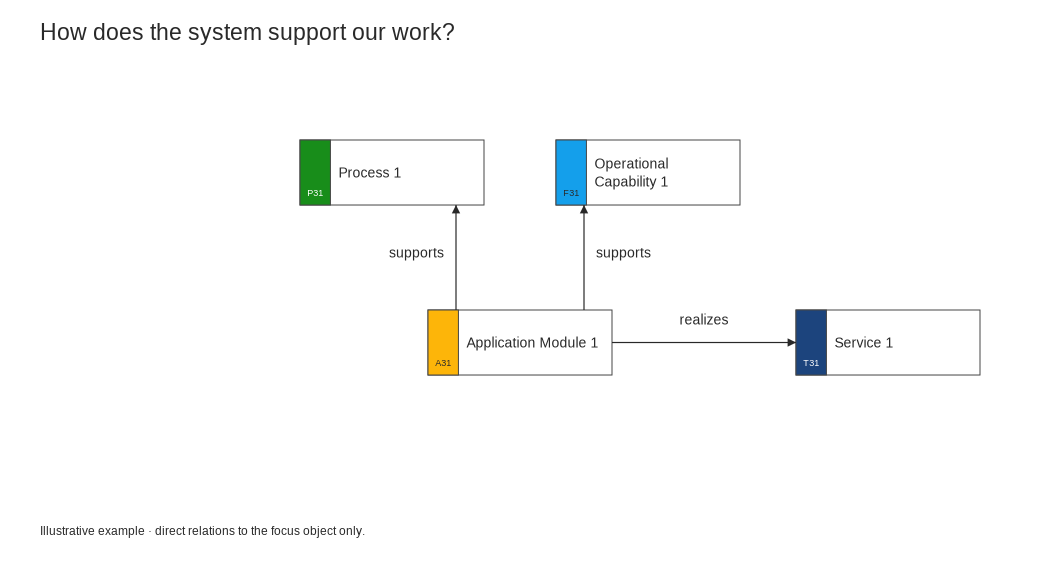
Read the example and its relationships → · Open larger image
What needs to work around this part of the system?
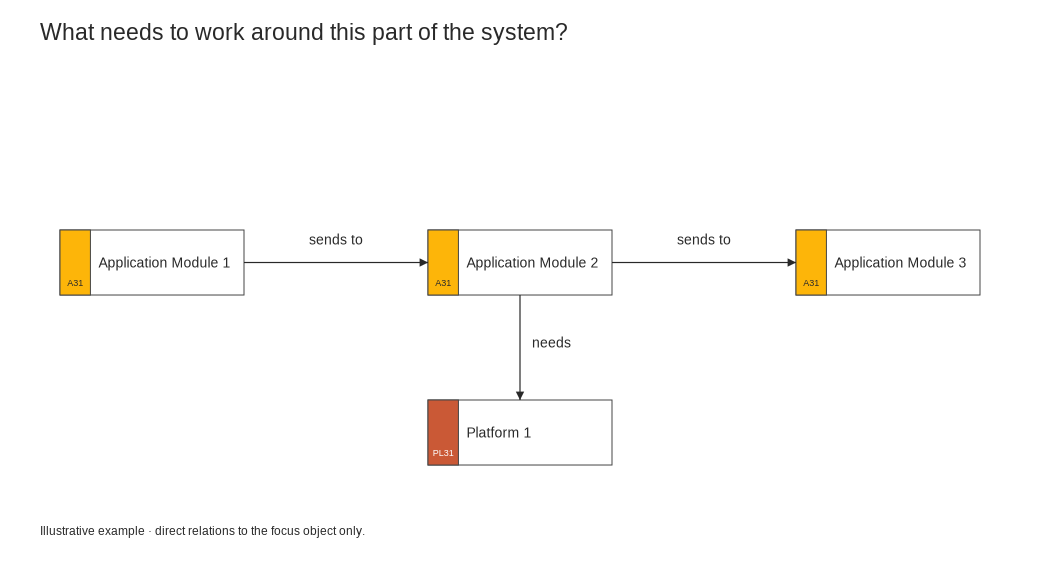
Read the example and its relationships → · Open larger image
Who makes sure the system support keeps working over time?
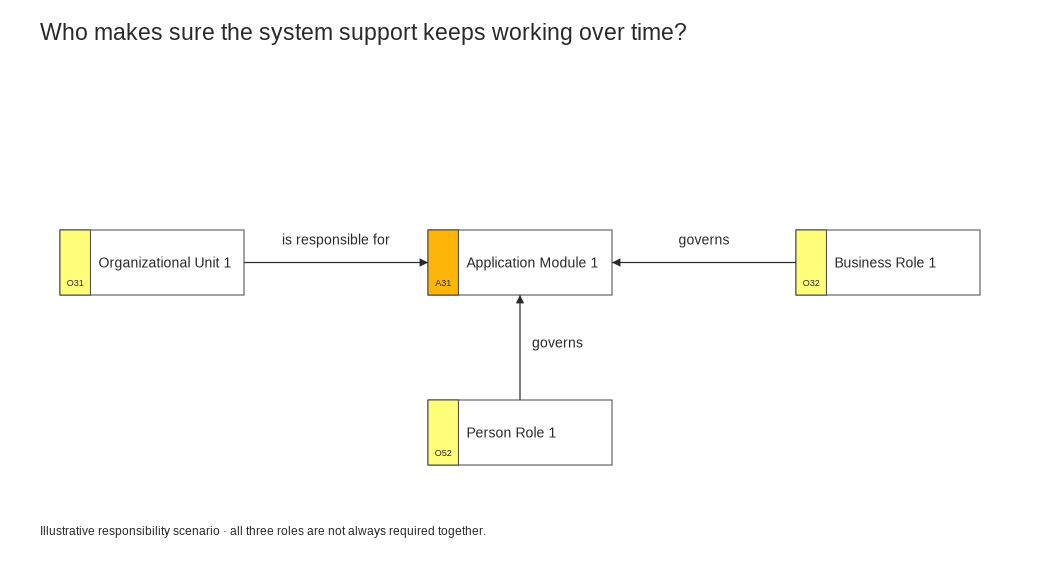
Read the example and its relationships → · Open larger image
Object types and relationships included in the view
PA_VT_0104
- A43 — Screenshot — Approved, implementation pending
A digital image depicting all or part of a display screen at a given moment.
- IM31 — Capability
A substantial deliverable designed for release at intervals of two to three months.
- D32 — Data Artefact
An identifiable data artefact that represents, structures, or carries data in a technical or modelled form.
- IM51 — Story
A short, simple, and bounded description of desired functionality from a user's perspective.
- IM21 — Epic
A very substantial deliverable that brings about a major change affecting several value streams.
- O32 — Business Role
Assigned responsibility at the organizational level for performing a particular task.
- O42 — Organizational Role
Assigned responsibility at the team level for performing a particular task.
- IM32 — Release
A work package representing the set of work activities needed to produce a substantial deliverable within a specified time and resource frame.
- PL31 — Platform
A foundation on which other applications, processes, or technologies run or are developed.
- X03 — Gap
A statement about the difference between different states or a comparison of different objects.
- X01 — Non-functional Requirement
A statement of a desired quality attribute of a solution.
- A32 — Application Interface
An access point through which an application service is made available to a user or another application module.
- A22 — Application Flow
A grouping of application modules that together form a flow.
- I41 — Entity Group
A grouping of information entities intended to achieve efficient information provision and high information quality.
- A41 — Application Function
A grouping of automated tasks.
- A31 — Application Module
An independent logical part of a larger application that has been given a specific purpose.
- A21 — Application
IT support that users commonly refer to when describing the systems they work with.
- D41 — Data Object
A logical grouping of data that represents a view of an information object.
- D31 — Data Component
A coherent collection of data that is part of an application.
- P51 — Activity
A task performed by a person, usually on one occasion without time gaps.
- P41 — Process Step
A series of activities that, together but not individually, create an artefact.
- P31 — Process
A chain of activities that creates value for one or more customers in a recurring flow.
- I31 — Information Object
A representation of information about a real-world thing.
- T31 — Service
Something a business offers to meet a recipient's need, with a clear boundary and conditions for its use.
- F41 — Functional Capability
The ability to perform a task.
- F32 — Business Function
A grouping of logically related tasks required to produce an outcome.
- F31 — Operational Capability
A holistic description of the business's ability to produce services and products efficiently.
- F21 — Business Capability
A holistic description of the business's ability to produce services and products in accordance with its vision and goals.
- R31 — Rule
Specifies the absolute norms that govern our conduct in a given situation.
- O52 — Person Role
Responsibility assigned at the individual level for performing a particular task.
- O51 — Position
An official area of responsibility intended for one person, also called an assigned position.
- O31 — Organizational Unit
A specialized functional division within an organization, also called a department.
- Application Function is part of Application Module · PA_RL_0053
- Application Interface sends to Application Module · PA_RL_0076
- Application Module uses Application Interface · PA_RL_0077
- Application Module provides Application Interface · PA_RL_0078
- Application Module sends to Application Module · PA_RL_0079
- Application Module has output Information Object · PA_RL_0080
- Application Module sends Data Component · PA_RL_0081
- Application Module is part of Application Flow · PA_RL_0082
- Application Module supports Operational Capability · PA_RL_0083
- Application Module realizes Story · PA_RL_0084
- Application Module supports Process · PA_RL_0085
- Application Module is part of Application · PA_RL_0086
- Application Module performs Activity · PA_RL_0087
- Application Module sends to Application Interface · PA_RL_0088
- Application Module realizes Business Function · PA_RL_0089
- Application Module is part of Business Capability · PA_RL_0090
- Application Module shows Gap · PA_RL_0091
- Application Module holds Data Component · PA_RL_0092
- Application Module supports Process Step · PA_RL_0093
- Application Module supports Activity · PA_RL_0094
- Application Module owns Entity Group · PA_RL_0095
- Application Module sends Data Object · PA_RL_0096
- Application Module realizes Rule · PA_RL_0097
- Application Module holds Rule · PA_RL_0098
- Application Module realizes Service · PA_RL_0099
- Application Module is part of Epic · PA_RL_0102
- Application Module needs Platform · PA_RL_0103
- Application Module developed from Application Module · PA_RL_0104
- Capability realizes Application Module · PA_RL_0166
- Data Artefact holds Application Module · PA_RL_0180
- Data Artefact realizes Application Module · PA_RL_0182
- Data Component is received by Application Module · PA_RL_0208
- Data Object is received by Application Module · PA_RL_0220
- Functional Capability is part of Application Module · PA_RL_0321
- Gap refers to Application Module · PA_RL_0331
- Non-functional Requirement influences Application Module · PA_RL_0359
- Information Object is input for Application Module · PA_RL_0396
- Platform holds Application Module · PA_RL_0571
- Platform supports Application Module · PA_RL_0583
- Rule regulates Application Module · PA_RL_0682
- Release changes Application Module · PA_RL_0809
- Screenshot is part of Application Module · PA_RL_0820
- Person Role uses Application Module · PA_RL_0929
- Person Role governs Application Module · PA_RL_1011
- Business Role governs Application Module · PA_RL_1175
- Organizational Unit is responsible for Application Module · PA_RL_1180
- Organizational Role uses Application Module · PA_RL_1238
- Position uses Application Module · PA_RL_1239